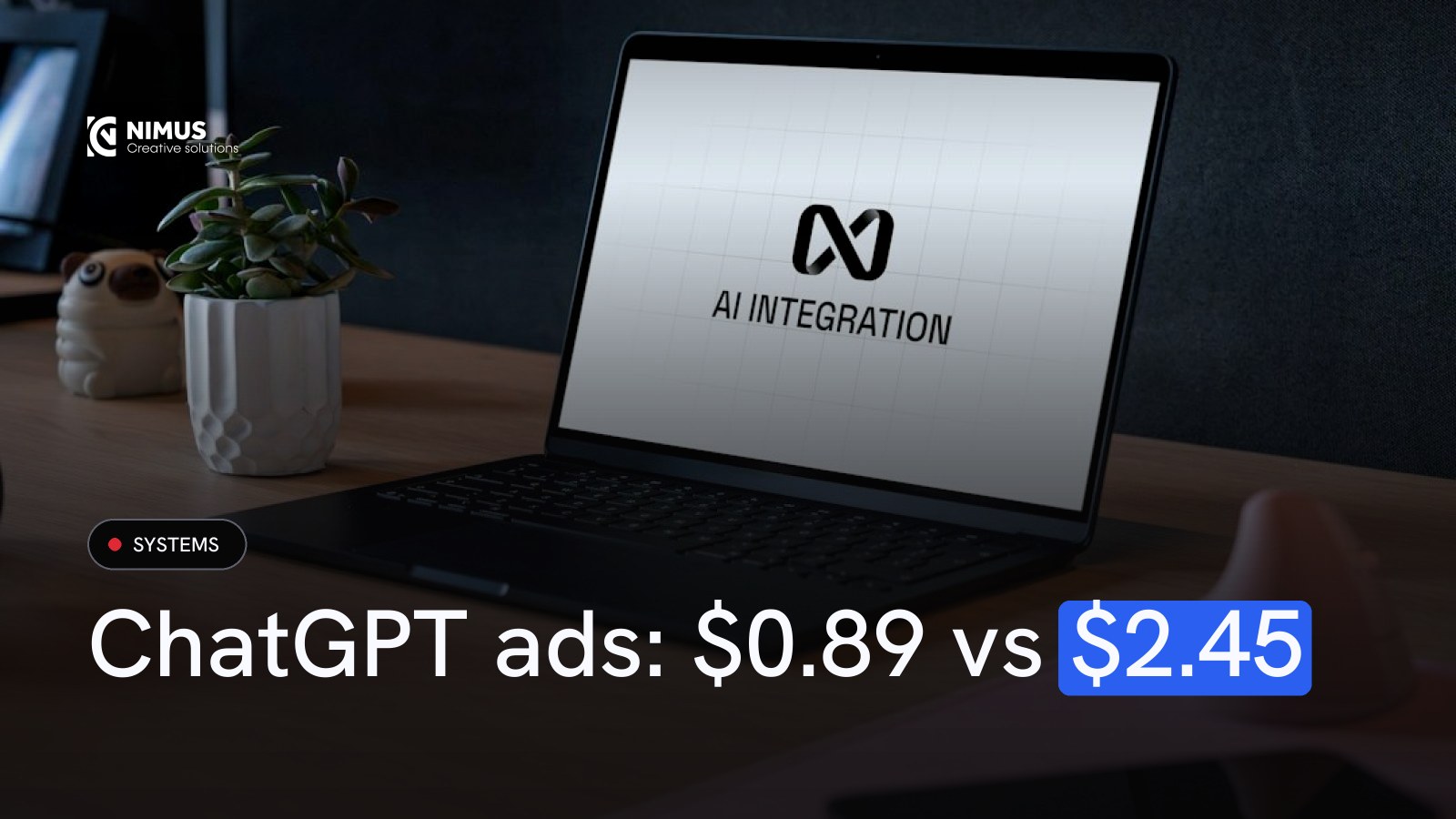
ChatGPT ad clicks earn shops $0.89 against $2.45 for Google search ads
A working paper dated October 2026 followed 1,898 online shops. In US traffic, a visit from a paid ChatGPT ad generated $0.89 in revenue, against $2.45 for a paid Google search visit. Organic ChatGPT referrals, by contrast, converted about as well as before ads arrived.

Representative image. Photo: Jo Lin / Unsplash
A working paper dated October 2026 has measured what ChatGPT's new ads are worth to online shops, and the answer is: much less than Google search ads. For any Kenyan business weighing a new channel, it is a useful reminder that a click is only worth what it earns after the visitor arrives.
- In US traffic, a paid ChatGPT visit generated $0.89 in revenue, against $2.45 for a paid Google search visit.
- Free ChatGPT referrals to shops did not convert worse after ads launched, though their volume may have dipped by roughly 6 to 8%.
- The data comes from US-led rollouts; the sources do not say ChatGPT ads are available in Kenya.
- The real lesson for Kenyan firms is to track revenue per source in a CRM, not just clicks.
What happened
Researchers Maximilian Kaiser (WU Vienna) and Christian Schulze (Frankfurt School of Finance & Management) studied ChatGPT's ad rollout using sales data from online shops. According to PPC Land's report on the paper, ChatGPT began showing labelled sponsored cards below its answers in February 2026, shown to users on the free tier and the low-priced Go tier.
The paper compares countries where ads launched with EU countries, which had no ads during the observation window. It covers 60 weeks and close to 10 billion visitor sessions drawn from Google Analytics 4 e-commerce tracking.
What is confirmed, and what is not yet known
The headline figure is a US one: $0.89 per paid ChatGPT visit against $2.45 per paid Google search visit. Paid ChatGPT visitors converted at 0.37% against 1.17% for paid search, and the report says the pattern was broad: 84 of 87 advertisers buying both channels earned less per ChatGPT visit.
The paper also says the picture is concentrated. One advertiser accounts for most paid ChatGPT revenue in the sample, and 73 of the 87 advertisers recorded no paid ChatGPT purchase at all. Removing the big advertiser made ChatGPT look worse, not better.
On the free side, the finding is more reassuring. Organic ChatGPT referral volume fell by an estimated 6 to 8%, but the authors describe that as a range across assumptions, and the basic estimate was not statistically distinguishable from zero. Conversion for those visitors did not move.
What is not known:
- Whether ads will launch in Kenya, or at what price. The sources do not say.
- Whether results hold outside the US. Brazil and Mexico had only two post-launch weeks in the data.
- What individual users saw. The tracking records the last click only, not prompts or ad impressions.
- The paper is version 1 and under review.
Why it matters for custom business systems
The study only works because the shops had tracking that tied each visit to a source and a sale. Paid ChatGPT traffic could be separated because it arrived tagged as chatgpt.com / cpc. In June 2026, Google Analytics also reclassified ChatGPT referrals under an ai-assistant medium, so the same source can appear under two labels in older and newer reports.
That is a systems problem, not a marketing one. If your website forms, WhatsApp enquiries and M-Pesa payments are not connected to the source that brought the customer, you cannot tell a $0.89 channel from a $2.45 one. You would be guessing.
What this means for Kenyan businesses
Nothing in the sources confirms that Kenyan advertisers can buy ChatGPT ads today, so this is not a call to buy them. The relevant points for Kenya are different.
- Free AI referrals are real traffic. In the paper, organic ChatGPT visitors converted at 1.31% and generated $2.48 per session across all countries in the financial sample. Some of your customers may already be arriving this way.
- Many Kenyan sales never touch a checkout. A lead who arrives from an AI answer, then calls or messages on WhatsApp and pays by M-Pesa, will vanish from standard e-commerce tracking unless you capture the source early.
- Ad prices tell you little without returns. The paper notes the largest publicly known account paid $1.72 per ChatGPT click, while the parity price was about $0.26. A cheap or expensive click means nothing until you know what it earns.
| Who | What changes | What to do |
|---|---|---|
| Online shops with GA4 | AI referrals may sit under two labels | Group both in reports |
| Service firms selling via WhatsApp or calls | Source is lost after the first click | Capture source in a CRM |
| Firms with ad budgets | New channels need proof | Compare revenue per visit, not cost per click |
Our analysis
This is our reading of the sourced facts, not a test result. The study measures last-click revenue per visit in the US. That is a fair test of whether a channel pays back, but a weak guide to a channel's wider influence. Someone may see an AI answer, search your name later and be credited to Google.
The likely mistake is to read "ChatGPT ads are poor" as "AI traffic is poor". The paper separates the two: paid visits underperformed, while free referrals converted like before. In the US, organic ChatGPT earned $3.27 per session, the highest of five channels. Treating them as one channel would hide that.
The second mistake is trusting averages. In the paid data, one advertiser carried most of the revenue. A Kenyan business with a few dozen leads a month will see the same noise, so judge channels over enough weeks and by closed sales, not enquiries.
The trade-off is effort. Source capture, pipeline stages and payment matching take setup, but without them every channel decision is a hunch. See also our guide to appearing in AI answers for the free side of this traffic.
Practical next steps this month
- Check GA4 for sessions from chatgpt.com, and combine any old referral label with the new ai-assistant medium.
- Add a hidden source field to your website forms and WhatsApp links so the origin of each lead is saved.
- Record each lead's source in your CRM and mark which ones become paying customers.
- Match M-Pesa payments to leads so revenue per source is visible, not just enquiries.
- Compare channels by revenue per visit or per lead, over at least eight to twelve weeks.
- Do not shift budget to any new ad channel until it shows returns against what you already pay for Google or Meta.
Nimus builds this plumbing under Custom All-In-One Systems: a CRM with a sales pipeline on your own stages, website and lead capture connected to it, and M-Pesa Daraja payments with reconciliation, so each shilling can be traced to the channel that brought the customer. If you first want to know where your sales engine leaks, start with the Sales Engine Audit.
Frequently Asked Questions
Can Kenyan businesses advertise on ChatGPT?
The sources do not say. They list launches in the US, Australia, Canada, New Zealand, the UK, Japan, Korea, Brazil, Mexico and later the EU, but not Kenya.
Do ChatGPT ads damage trust in the product?
The authors found that ads had not substantially diminished the value of the product, using conversion as a proxy. They note limits, including how uneven the country data was.
Is the $0.26 figure a real price?
No. It is the authors' calculated parity price: what a ChatGPT click would be worth if it returned as much per dollar as a search click. Their resampled range was wide, from $0.05 to $0.57.
Sources
- ChatGPT ad visits earn shops $0.89 against $2.45 for Google search ads, PPC Land, 2 Nov 2026
Written by the Nimus Newsroom with AI assistance from the sources above, and checked against them before publishing. Spotted an error? Tell us through the contact page and we will correct it.
Want This Built For Your Business?
This is exactly the kind of thing we build. Book a free call and I'll tell you where to start.
Free download for this topic: Website Launch Checklist